
Nature Journaling at Last!
And a Lenten update on pain management

I’ve been certain, for years, that nature journaling would become a rewarding practice, but I’ve not encountered the reward. Instead, I’ve discovered it is an intense, time consuming practice — basically botanical illustration — with little room for expressiveness. The few times I’ve attempted it, I did not stick with it with any consistency. It was just occasional botanical illustration when the muse hit hard enough for me to accomplish accurate realism. I’m an impressionist by nature.
That all changed when I was gobsmacked to learn about a timeline approach, thanks to Raspberry Thief Nature Journaling on Substack. I wanted to comment “STEALING” because her timeline format takes all those botanical bits and puts them in succession, and a larger picture emerges with stunning beauty. I am all about charts and graphs and timelines, a good layout and beauty. I was also a freelance graphic designer for decades.
Furthermore, she broke the four seasons in half, using Celtic dates which we still adhere to in the West, thanks to the Catholic Church instituting spiritual markers over the pagan: Yule and Candlemas come readily to mind.
I’ve decided to make one continuous timeline for each half season, but will use gardening terms over the Celtic names.
March 20 Vernal Equinox & Early Spring
May 1 Late Spring
June 21 Summer Solstice & Mid Summer
August 2 Late Summer
September 22 Fall Equinox & Early Fall
October 31 Late Fall
December 21 Winter Solstice & Early Winter
February 2 Late Winter
Here is the first page of Early Spring … the perfect time to begin the cycle:
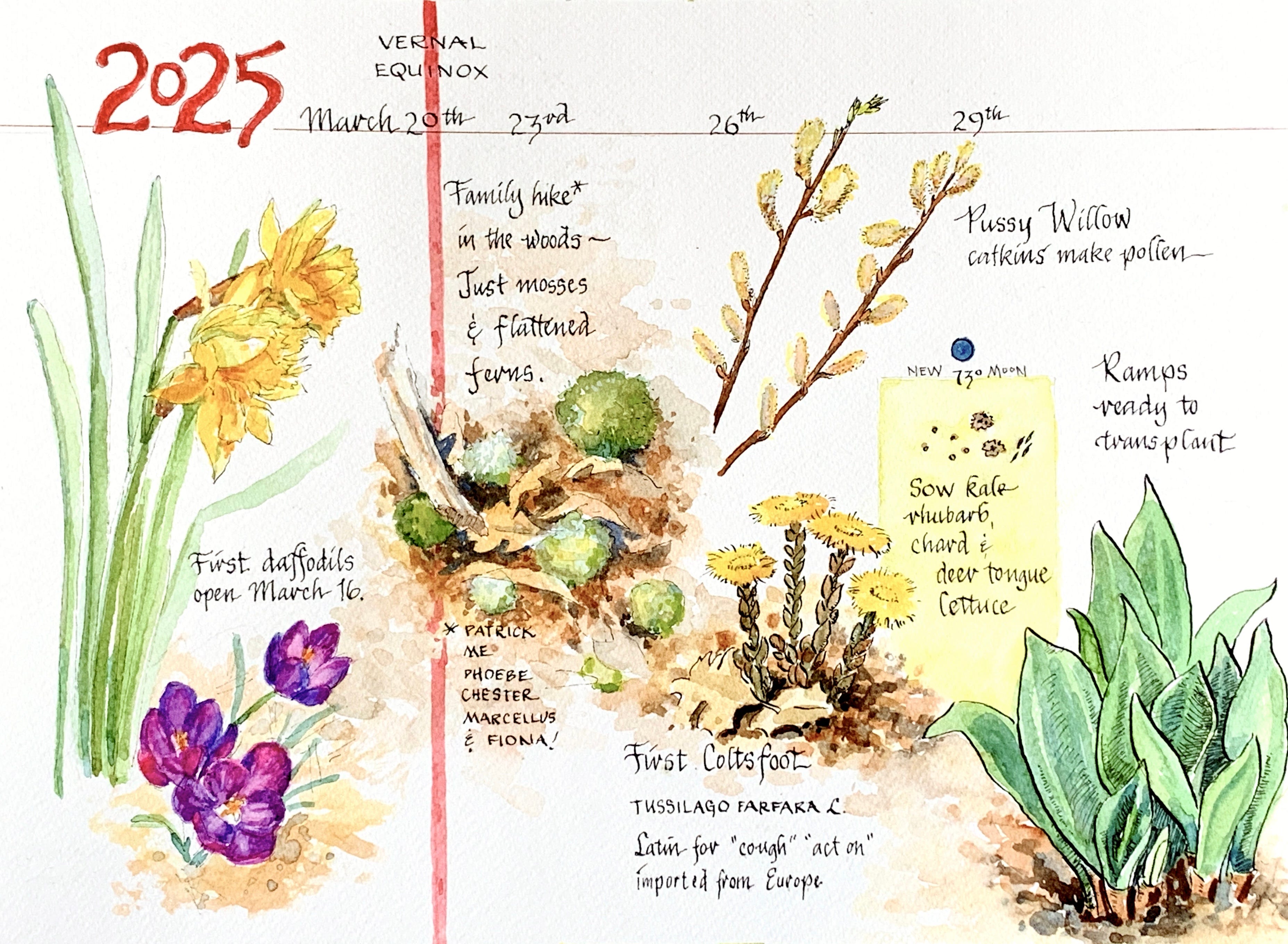
This is a major time commitment and will replace a great deal of the usual artwork I make that I frame and attempt to sell at galleries. I am working now on my second page of Early Spring:
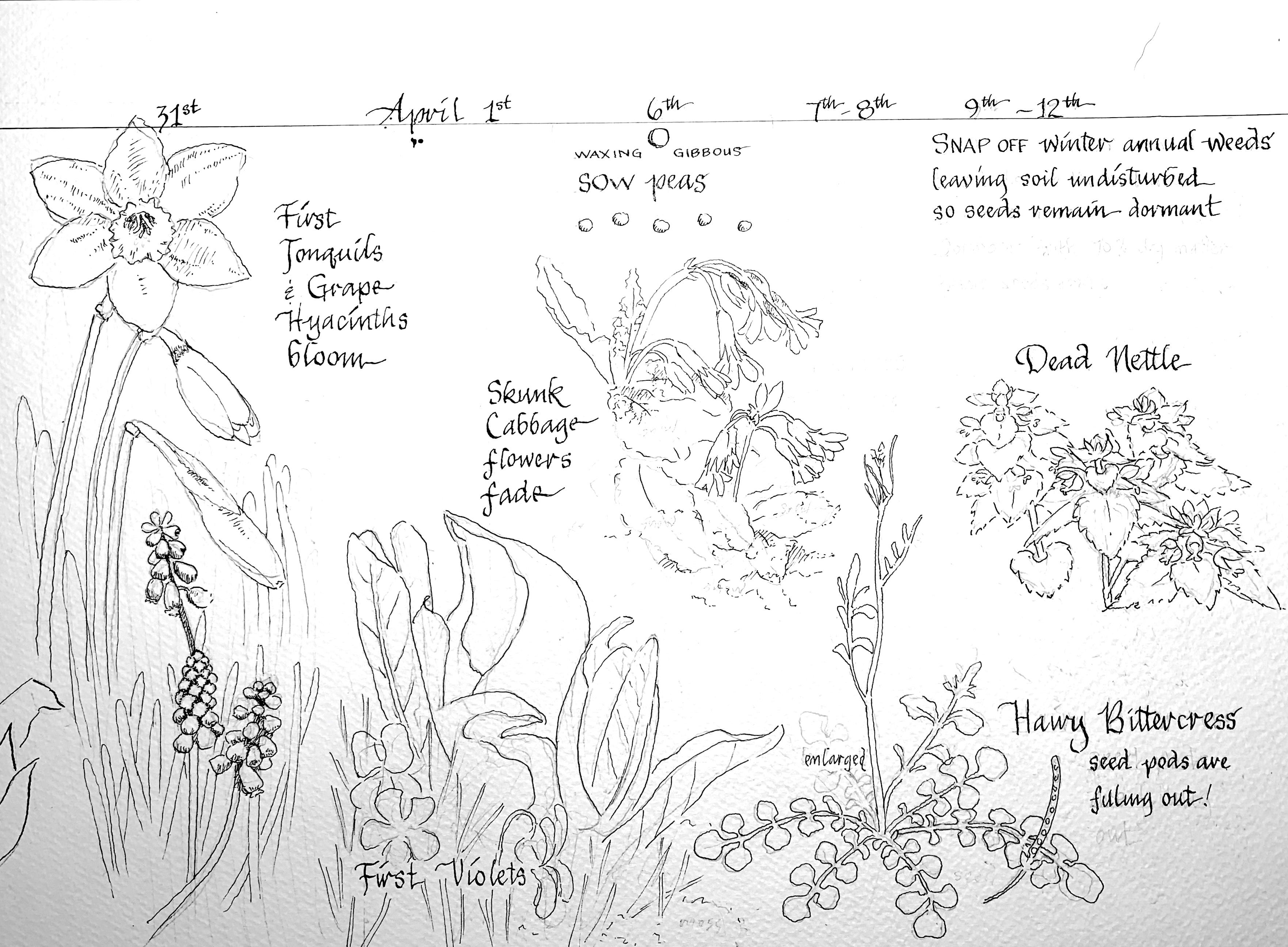
I need to add back SNOW under the 7th-8th and label the Primoses “looking droopy”. This took three days of penciling out placement and lettering, then hours of inking. I now enjoy it enough to look forward to the hours invested, but must ask myself —
Why Nature Journal?
I wrote in my regular journal this morning “… the world is shifting and I feel powerless. I cannot simply put my fingers in my ears and sing ‘la la la’ and yet, when I take the time to articulate kingdom-thinking my voice is garbled …” Is nature journaling a form of avoidance? Shouldn’t I be DOING SOMETHING to improve my ability to inform others of the refuge of the Kingdom of God in these times? Call it missionary complex. I am one half of a missionary couple and can’t escape it.
“I must work on … improving my written and visual vocabularies.” I concluded. “That is the task at hand. Nature journaling is not ‘la la la’ — it improves my understanding of botanical marvels and commits them to memory. And, when published, it makes that understanding accessible to others — especially those who choose to look deeply.”
Why the apocalyptic urgency?
I currently keep up with the news, oh my! — and the Substacks of Rod Dreher, Paul Kingsnorth and Mary Harrington, to name a few … I recall Kingsnorth writing that “apocalypse” is simply a mega-shift from one age to another. We are, he writes, in the age of the machine. I relish Harrington’s insights along that line, and recently listened to her podcast with Jonathan Pageau where she expounded on how artificial intelligence is driving a shift in humans away from “identity” or “the self” of modernity and back to “the soul” of the Middle Ages. AI can fiddle with human identity, and does, because identity is formed by what we post on the internet. It’s our collective brand. Identity has never been an accurate model of our true ontological selves; it is a glossed over facade of humanity. AI can also intersect with “the self” on a broader scale because that construct is based on behavioral psychology apart from God. In fact, AI is driving human behaviors on a daily basis and mucking with our psyches in news feeds and algorhythms.
The only ontological model of humans AI has no power to influence is “the soul”, which lives within us as the life force or breath of God. The soul is trending.
The Biblical English “soul” is “nephesh” in Hebrew and “psyche” in Ancient Greek and literally means “breath.” In Genesis 2:7 Adam became a “nephesh” or living soul. The Greek is a bit more layered 1 and another word “pneuma” which also literally means “breath” and is translated “spirit” injects an immortal state that survives the death of the body elsewhere, which the Hebrew does not imply: no breath = no life … it’s mortality all the way. I’m not sure where Mary Harrington stands, but I prefer the Hebrew interpretation which intensifies for me the work of Christ’s resurrection whereby our mortal condition can now be transformed by faith: “the mortal must put on immortality.” 2
We all breathe. Therefore we possess God’s life force while we live. The life we experience in spring, summer, fall and winter amplifies this Divine animation. Why nature journal? When I observe and illustrate living things in detail, I am celebrating God’s creation as His ongoing, living work throughout the seasons, revealing life, death and life again.
My Lenten update
I last wrote “For Lent, I am abiding by a self-induced program of curtailed activity which may last the rest of my life!” The good news is routine activities are not curtailed so much as modified. I do everything by halves now to minimize the strain on my bone-on-bone right thumb, and that seems to be working thus far. I’ve not had another awful pain “level 10” flare up or swelling since February, even though I’ve been weeding and sowing, vacuuming and driving. Limiting myself to an hour a day of outside work and doing dishes two to three times daily so as to not handle so many, and vacuuming sections of the house instead of the whole house, etc. is working so far. Things are still getting done … by halves.
I am in the fall of my own life, but there is still life a bit more slowly. And the new practice of nature journaling is keeping my feet on the ground.
This is my Father’s world,
And to my list’ning ears
All nature sings, and round me rings
The music of the spheres.
This is my Father’s world:
I rest me in the thought
Of rocks and trees, of skies and seas—
His hand the wonders wrought.This is my Father’s world:
The birds their carols raise,
The morning light, the lily white,
Declare their Maker’s praise.
This is my Father’s world:
He shines in all that’s fair;
In the rustling grass I hear Him pass,
He speaks to me everywhere.This is my Father’s world:
Oh, let me ne’er forget
That though the wrong seems oft so strong,
God is the ruler yet.
This is my Father’s world,
The battle is not done:
Jesus who died shall be satisfied,
And earth and Heav’n be one. — Maltbie D. Babcock, 1901
My source is the Strong’s Concordance via searching the New Testament “soul” and “spirit” for the original Ancient Greek with the Touch Bible app. It’s quite the rabbit hole and I’ll be digging deeper with these tools soon and plan to write on what the resurrection means for mankind in light of these ancient words that reveal true human identity.
I Corinthians 15:53-55 “For this corruptible must put on incorruption, and this mortal must put on immortality. So when this corruptible shall have put on incorruption, and this mortal shall have put on immortality, then shall be brought to pass the saying that is written, Death is swallowed up in victory. O death, where is thy sting? O grave, where is thy victory?”
I started a nature journal this year and each month use a phenology wheel to better sync my heart and mind with the rhythms around me. I love your art!
I had no idea that my work had inspired you Lynda, I didn't get a notification of your tag. I am so happy that you have begun your journey into getting to know your patch, and document it. I think 'nature journaling' is so important in so many ways. It is a constructive/creative way to make sense, learn, keep a record, to deepen your faith and not feel despair. Thank you for sharing your page.